

Extra: The Digital Delusion
Comments on a new book by Jared Cooney Horvath
This is an interim special issue.
Fortnightly199 will be along next Saturday.

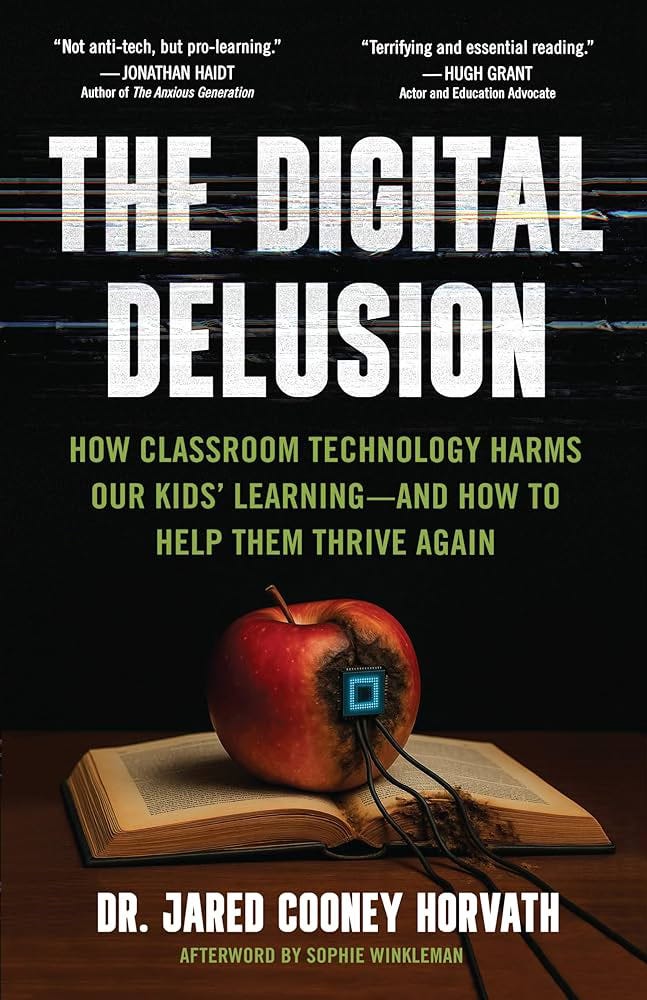
Until the last couple of years it had seemed that the relentless encroachment of online technology on children’s lives was impossible to resist. But at least recently there has been more awareness of the damage social media in particular, supercharged by smartphones, has done. There is certainly more effective resistance to this from parents and schools now, even if the pressures from mega tech companies seem overwhelming at times.
Parallel to, and overlapping this, is the longer-standing relationship between learning and technology, another instance where a powerful force has been all too frequently waved into children’s lives without any guardrails or evidence-base. In his new book, The Digital Delusion, the neuroscientist Dr Jared Cooney Horvath examines, in the words of the subtitle, how classroom technology harms our kids’ learning - and how to help them thrive again.
This is the best single book I have come across which confronts head on the absurd assumption, shared by so many including our own educational authorities in Ireland, that the digital is by definition a positive force in learning for our pupils/students. It is key that the author has neuroscience training, since so much of the first third of the book shows why that is an absurd assumption. All too few people have a basic grasp of cognitive science and why technology can be a corrosive influence on learning, but Horvath lays out the basics in a clear manner. He has a gift for explaining these things in a punchy and memorable way. Those interested in the evidence underpinning this can turn to the well-resourced detailed citations section at the back, which takes up about a fifth of the book.
It is difficult not to be cynical about the adoption of hard and soft tech tools for children, given the immense financial forces behind these, and the recent developments in publicly available AI entirely confirms the rightness of such scepticism. Hooking in children to become loyal (and profitable) customers for life has plainly been a winning strategy for tech companies for decades. As Horvath shows, this has not been justified by improvements in learning: in fact, EdTech platforms often degrade it:
Tools don’t fail at random; they fail for reasons. In the case of EdTech, those reasons are rooted in the architecture of the human mind. Digital tools clash with the way human beings are built to learn.
In Chapter 1, he examines ‘the five myths that built EdTech’ and which emerge from that problematic DNA:
Education is broken (the oldest cliché of all?).
Multimedia enhances learning.
Free choice leads to better learning.
Kids learn best on their own.
Intelligent tutors make kids more intelligent.
Sadly, many people in education have swallowed whole these ‘seductive’ but flawed assumptions. Horvath quotes Professor Dylan Wiliam:
Technology is the revolution still coming after 50 years.
Daisy Christodoulou’s Teachers vs Tech looks at this long history of disappointment (my review).
Horvath explains clearly why those myths are just that, including an overview of basic cognitive processes, many of which are still not known to many people, including teachers. These include the notorious ‘Learning Styles’, the impossibility of multi-tasking while paying attention, and the unsuitability of digital tools for deep thinking:
The very fact that digital tools reduce effort means the skills they promote tend to be shallow.
and
The purpose of education is to prepare kids for an ever-changing world—to build skills they can carry into new and unpredictable situations. Digital learning delivers the opposite. It flattens experience, making knowledge harder to recall and apply outside the device.
He goes on to address the arguments made with wearying frequency by ed-tech evangelists (all too often with no expertise in teaching and learning), and gathers these up into eight ‘apologies’, filleting each one in turn: (1) EdTech has so much potential, (2) We need more time, (3) Digital devices are ubiquitous, (4) Kids need digital skills to be competitive, (5) Modern students learn differently (oh Lord - no they don’t, no more than they breathe or digest differently), (6) People are using EdTech incorrectly, (7) Don’t let your school get left behind, and (8) It’s just a tool.
Much of this nonsense has been dismayingly supercharged since ChatGPT launched, followed by a host of similar AI tools:
Imagine this: a pharmaceutical company develops a new drug. The problem? They have no idea what it does—no clue what it treats, how effective it is, or what side effects it might have. Undeterred, they release it globally with no testing or usage guidelines. Rather than pushing back, governments, businesses, and schools all jump on board. Billions of doses are handed out, and patients are told to figure out for themselves what the drug is good for.
And here we are a few years later into this experiment with the tool nobody asked for, solving problems nobody had (in learning). I have felt this from the start about GenAI, and no instance has challenged that reaction since. Whatever benefits GenAI might have for teachers (there are downsides), I have yet to see any upside for learners in an English class. Worse, it actively degrades understanding and learning. AI is a terrible tool for novices, though potentially a helpful one for experts, a term which you would hope includes teachers.
In his comments on AI, Horvath comes to one of the modern era’s greatest thinkers on technology, Neil Postman, and his superbly prescient 1993 book Technopoly: the surrender of culture to technology. I wrote about this extensively almost a year ago. Horvath comments
This is why schools must reclaim their primary role—not as content providers, but as meaning-makers. School may be the only consistent (if imperfect) conductor: human in design, clear in intention, and grounded in purpose. If schools surrender this role to machines, they will not survive in the world AI is working to create—and I fear neither will any remaining sense of coherence.
Part 3 of The Digital Delusion is called ‘Pushing Back’ and provides paths forward for parents and teachers who wish to stand up to the tide of counterproductive technology in our schools, to fight back, including templates of documents for advocacy, much in the spirit of Jonathan Haidt’s smartphone and social media campaign (a puff from Haidt is on the front cover). I’ll skip over that in these comments, and end with a handful of pertinent statements from the book. Best of all, get a copy and read the most accessible book there has yet been on how online technology damages learning.
Many people believe that thinking happens entirely in the brain, as if we’re just gray matter hitching a ride inside a body. But this misses something essential: we don’t merely have bodies—we are bodies. Learning doesn’t arise from the brain alone; it emerges from the rhythms, movements, and sensations of our entire physical selves.
To hold attention, digital tools must move fast: flashing visuals, short videos, infinite scrolling, constant rewards. But real learning requires the opposite: stillness, stability, and sustained thought. The very features that keep students glued to their screens are the same ones that make deep thinking impossible.
One of the main selling points of digital technology is that it makes tasks easier. Typing is less strenuous than handwriting; following GPS commands is less demanding than reading a map; spellcheck requires less effort than editing your own prose. In the professional world, this efficiency is an undeniable boon. But in the classroom, it is technology’s Achilles heel.
Driving. Health insurance. Alcohol. Taxes. Video games. Dating, marriage, and divorce. Student loans. Pregnancy. Litigation. Television. Stock investments. Table manners. Job applications. Self-defense. First aid. Pet care. Yoga. I’m listing these not to be exhaustive, but to make a point: ubiquity alone doesn’t justify inclusion in schools. Teachers have always understood they’re not the only educators in a child’s life. Many essential life-skills are best learned through family, peers, and real-world experience—not in the classroom. Consider driving. You might believe schools should teach students how to drive. Fair enough. But it doesn’t follow that schools should now teach every subject in a car. What we teach and how we teach are not the same. And this is where the apology from ubiquity collapses. Through a kind of linguistic sleight of hand, the claim “Schools should teach computer skills” has morphed into “Schools should teach all skills through computers.”
Using AI to skip the slow, sometimes tedious work of learning isn’t the key to developing higher-order skills; it’s the surest way to prevent them from emerging at all. Without deep, internalized knowledge, critical thinking stays shallow, creativity remains imitation, and the real work of the mind never begins.
The more abundant and decontextualized information becomes, the more we need strong organizing structures.
When teachers outsource planning, assessment, and feedback to AI, they imply that meaning-making is beyond human capacity. And if teachers can’t fulfill their core function, why should we expect any more from students? If human thinking is subordinate to AI, then the future of school isn’t learning—it’s training.
Gyms exist to build physical strength through hard work and struggle. Imagine if a gym invested in machines that did the work for you: treadmills that ran on their own while you flipped through a magazine; weights that lifted themselves while you sipped a smoothie. No one would mistake that for exercise, and no one would expect to grow stronger or healthier. The mismatch between tool and purpose is obvious.
Finally, the core truism:
The only essential ingredients for learning are a curious child and a willing teacher. Everything else is just decoration.
with Anna Stokke
Here’s a recent conversation on the ‘Chalk and Talk’ podcast.
Amen.
Had a chuckle that Hugh Grant was quoted on the cover.